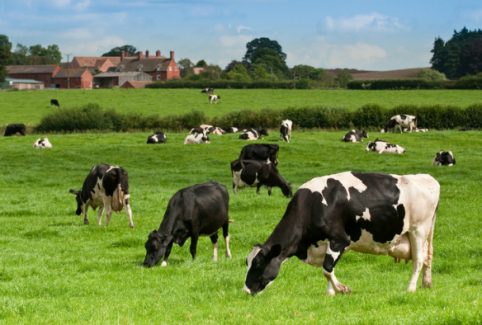
Milk prices have fallen so sharply amid a glut in supply that dairy farmers Kelly and Ed Seaton expect to lose money this year from the 200 pedigree Holstein cows they rear in northwest England, where the weeks-old calves are just finding their feet.
Across Britain, dairy farmers warn milk production is no longer profitable, leaving many at risk of going out of business and accelerating an exodus that has seen the number of dairy producers fall by 20% since 2019 to about 7,000, according to the Agriculture and Horticulture Development Board.
The price paid by processors to many UK dairy farmers has fallen by up to 15 pence per litre (ppl), or about 40%, since October 2025, as domestic and global milk production soars.
U.S. and European milk production has rebounded this year after a weak 2025. In Britain, the milking herd numbered 1.6 million cows as of January, the lowest in a decade, yet the animals are producing more milk. Drought conditions in the UK last year led farmers to rely more heavily on concentrated feed, in place of grazing, resulting in higher milk yields.
Britain is just under 90% self sufficient in dairy, but because milk is a globally traded commodity, UK prices are exposed to factors beyond domestic control and prone to volatility. The downturn has been far faster and steeper than analysts expected, giving farmers little time to adapt.
“For the past few months, we’ve truly seen a tsunami of milk supply worldwide,” Francois-Xavier Huard, CEO of French dairy association FNIL, said last month.
Her revenue this month will be about 20,000 pounds ($26,684) lower than September’s.
“We’ve never seen price cuts on this scale – they’re savage cuts in such a short period,” he said.
Paul Tompkins, whose farm in the Vale of York in northern England rears 500 Holstein cows, said he’s on track to lose about 600,000 pounds this year, having made a profit in the preceding two years.
He said unless UK dairy farmers had cost-of-production-aligned contracts with one of the major supermarket groups they were likely losing money. “The question for us as an industry is how do you manage increasing price volatility going forward,” he said.
UK milk production typically surges in spring when more cows calve, heightening the risk of an even larger surplus that could push prices down further.
The British dairy sector is worth more than 6 billion pounds a year to the UK economy and contributes 20% of agricultural output, according to the agriculture ministry.
Tompkins, who is also deputy president of the National Farmers’ Union, said the government could have done more to help the industry, which is also grappling with higher labour costs, inheritance tax changes, and now sharp rises in fuel, energy and fertiliser prices linked to the Iran war.
The price slump comes just as demand for dairy foods is expected to rise. A growing global population with more income is embracing dairy as an affordable protein and ditching ultra‑processed food, while countries such as China are adopting a more Western‑style diet.
Global per‑capita demand for fresh dairy products is forecast to increase by 11% over the decade to 2033, according to OECD/FAO projections.
The NFU warns that without a more resilient and profitable dairy sector, UK food security could be put at risk.
“Ultimately you become as an industry more susceptible to large corporations getting larger, fewer farmers, fewer processors and people looking elsewhere to get product in,” said independent farm consultant Paddy Snodgrass.
Source: Reuters.com / James Davey