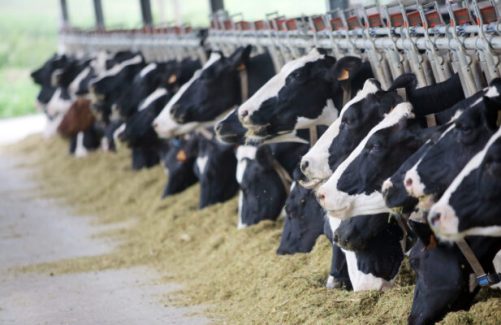
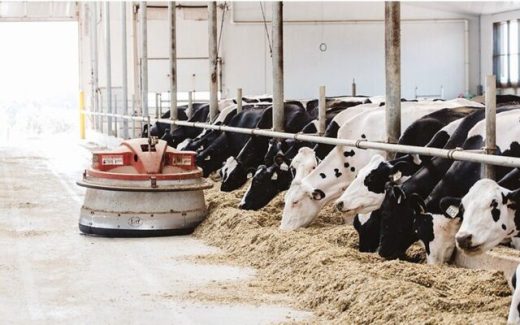
Wagyu isn’t your everyday, run-of-the-mill piece of beef — it’s a luxury item due to its intense marbling, tenderness, juiciness and rich flavour.
A producer in Saskatchewan is bringing that luxury to his operation by combining Wagyu genetics with Holstein in a beef-on-dairy system.
“It just kind of grew out of curiosity, turned into an obsession, going down a YouTube rabbit hole with everything Wagyu beef. And I became quite intrigued with it,” said Ian Crosbie, one of the owners and operators of Benbie Holsteins, from Caron, Sask.
Crosbie’s family has raised dairy and beef animals for generations, but he was the one who decided to do something different.
Considering both himself and his wife to be “foodies,” Crosbie became more and more interested in Wagyu, and in 2018, he started to combine Wagyu genetics with his Holstein genetics, creating what he refers to as “snow beef.”
“Trying to make a product that was the creme de la creme of beef intrigued me quite a bit,” Crosbie says.
Wagyu beef comes from four Japanese cattle breeds — the Japanese Brown, Japanese Shorthorn, Japanese Polled and Japanese Black, though over 95 per cent of Wagyu beef is from the Japanese Black breed. The term Wagyu directly translates to “Japanese cow.” Over the years, Wagyu steaks have become well-known for being one of the best varieties of beef in the world. This is not only because of the marbling, but because of the amount of fatty acids in Wagyu beef, which isn’t present to the same extent in western Canadian cattle breeds.
In Canada, it is rare for farms to raise purebred animals for Wagyu beef; it is more common to combine the genetics with other commercial breeds. In Crosbie’s case, he does this with his dairy herd.
Crosbie got his Wagyu genetics from Wagyu Sakai in Puslinch, Ont., because the owner of Wagyu Sakai has direct connections to the first genetics imported from Japan.
“Going right to the source, the knowledge that they had with pedigrees and lineage, I figured that would be a good place to start. So they definitely helped me get my feet off the ground as far as breeding and using the proper genetics,” Crosbie says.
When combining Wagyu genetics with Holstein, Crosbie says it doesn’t make for a visually appealing animal. But he likes the temperament of the Wagyu animals, and the benefits they bring to his dairy herd.
When combined with the Holstein genetics, Crosbie sees a benefit. Because the Wagyu breed is so much smaller, it makes calving much easier. A stress-free calving with low birth weight means the cows are set up for good lactation.
The proof, though, is in the carcass quality and the marbling, but that doesn’t happen immediately. This has to do not just with the genetics of the animals, but also with how they are raised.
One thing Crosbie tries to do is raise his snow beef as close to how Wagyu animals are raised in Japan, which is very different from a western Canadian feedlot.
In a Canadian feedlot, the goal is the least amount of days on feed to maximize weight gain and to keep feed costs low. But for Wagyu beef, animals are left on feed longer to develop better marbling and fat quality. They are also fed a more concentrated diet.
“Everyone is just looking for the least amount of days on feed to get the maximum pounds as quickly as you can, because your feed costs are your number one input that’s going to determine whether you’re making any money or not,” Crosbie says. The longer days on feed are reflected in the price of a luxury product such as Crosbie’s snow beef.
Crosbie raises his snow beef calves side by side with his purebred Holsteins until 18 months of age.
Before weaning, they live in the nursery and are pail-fed, up to 10 litres a day of pasteurized milk. At three months of age, they are transitioned onto a forage-heavy diet consisting primarily of barley, corn and triticale.
At 18 months of age, they move into the finishing program, where they are fed through a creep feeder. Their diet then consists of barley, oats, canola meal and some mineral premix.
They also get oat straw, to mimic the rice straw cattle in Japan are fed.
“Typically in Japan, they’ll feed them a very concentrate-heavy diet, and rice straw, that’s all they’ll get. So obviously, we’re not growing rice out here in Saskatchewan … so oats would be about the next closest thing that we could mimic the rice and the properties that we get out of that.”
Beef-on-dairy systems are becoming more common in Canada and the United States as the beef cattle herds shrink. Combining beef genetics with dairy offers a unique opportunity for dairy producers to fill the gap in the beef industry and to improve their own bottom line.
Since the 2000s, dairy producers have been using sexed semen to get 90 per cent or higher female dairy calves. This is because male calves don’t provide much economic return aside from beef — almost all dairy operations use artificial insemination.
But, with beef-on-dairy, dairy producers can make the most of their calves and improve the carcass quality of their cattle.
According to a 2024 presentation by Kee Jim, senior lead of animal agriculture at Telus and managing director for G.K. Jim Farms, Holstein steers comprised 17 to 22 per cent of fed beef production.
“If you (went) into a grocery store at random and (chose) a steak, one in five times that animal originated from a dairy and was likely in the past a Holstein steer,” he said at the 2024 Canadian Beef Industry Conference.
Crossbreeding improves meat quality without affecting milk production. According to Jim, other benefits are improved marbling, average daily gain, yield grade, quality grade and carcass cutability.
For Crosbie, he not only uses Wagyu genetics to crossbreed his Holsteins, but he also uses Charolais genetics.
“Once these calves hit the ground, just that Charolais advantage of always having that silver hair coat just jumps out for the cattle purchasers … and they’re not too scared to go ahead and spend the same dollars that they would with a commercial beef calf.”
With beef-on-dairy improving his bottom line, Crosbie is also seeing benefits to his operation, especially given how good beef prices have been in the past few years.
“The past six, seven years have been pretty lean in the dairy industry as well. Profit margins have not been where we would like to see them. There’s been a lot of producers struggling, and to have this cash flow coming in from these beef-cross calves … it’s sure helping the bottom line out on our operation.”
According to Jim, there is a benefit to this system for beef seed stock producers, as well.
“If you’re a seed stock producer in North America, you got to be pretty happy with this deal, because now you have a customer that is going to be able to sell a large amount of semen. We’re not talking hundreds of thousands of doses here. We’re talking millions of doses.”
When he first started, Crosbie hit the ground running with his snow beef product and had many customers, such as Crave Kitchen and Bar in Regina and Prairie Meats. However, when COVID hit the economy, it hit his business, too. Consumers couldn’t afford luxury meat.
Now, five years later, he is rebuilding the business and has a deal with Babco Meats out of Regina, and he hopes to continue serving his customer base. He has had interest from consumers all over the country, but provincial regulations mean he can’t sell his product across Canada.
He expressed disappointment with the provincial government’s regulations, as he feels they prevent him from selling to customers who would be interested in snow beef.
The issue encompasses Saskatchewan’s meat inspection at abattoirs, as well as restrictions around interprovincial trade. Beef must be slaughtered, processed and inspected at a federally licensed abattoir to be sold outside the province. That’s not realistic for operations like Crosbie’s.
“For the foodies out there, they’re the ones that would really care about it. And with beef, there is always subtle nuances from the region, breed, whatever it may be … and we’re just not, unfortunately, able to try that out.”